

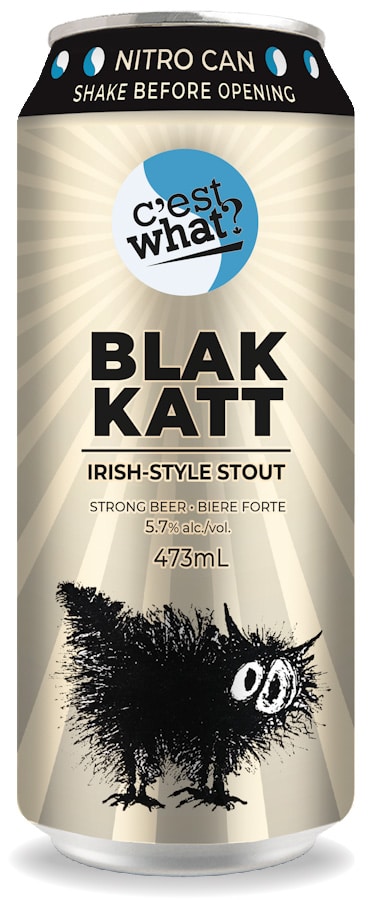
Who are you calling Stout?
With cooler weather on the horizon, interest in roasty, malty, creamy, dark, delicious porters and stouts will be on the increase. But what’s the difference between a porter and stout?
The history of the porter goes back about three hundred years, where it was brewed as a full-bodied beer made using moderately kilned brown malt. Stronger versions of porters were referred to as “stout porter” or a “stout” for short.
Initially, the word stout was used to describe any strong beer regardless of style, but as the popularity of the stout porter outstripped that of a regular porter, the word stout became synonymous with strong black beer.
Some brewers today maintain that malt defines the difference between a porter and stout where a porter uses mostly malted barley and a stout primarily uses roasted unmalted barley, giving it a drier, roasted coffee flavour. On the other hand, it was not until 1880 that the United Kingdom permitted the use of roasted barley and stouts were being made long before it was a legal ingredient.
In the end, beer aficionados have concluded that there’s no fundamental difference between a porter and stout, as they once began as a single style. As the beer world evolves, the decision to name a porter or stout comes down to the brewer’s prerogative or personal preference.
A story to illustrate:
I’m chatting to the brewer at The Old Harbour brew pub (sadly, now closed) in San Juan PR. You could easily tell he was the brewer; he was the only one wearing Wellington boots, along with shorts and jazzy shirt.
“Ah, Señorita, I see you ‘ave our Cervezia Kofresi. Waddayou think of our stout?” he asks, with a proud, expectant smile.
I sip again, then hesitate before I answer. His smile drops a little.
“Wandering towards a porter, I’d say?”
His head starts to lower a little, “Si”, he says looking slightly embarrassed. “- but it is hard to get the right ingredients way out here”.
I drink again and knowing smiles return to both our faces.
Both ales and often very similar in appearance, it can be a tough task, putting into words just what the differences are between stout and porter. Our senses of smell, taste and touch (‘mouthfeel’) give us that instant recognition – few could confuse a Dublin Guinness and a Fuller’s London Porter, two globally recognised benchmarks of these two basic styles.
The dry Irish stout shows distinct English hop notes along with its burnt – acidic, not strong – notes from the heavily-roasted unmalted barley that is added to the usual pale malt to give it its distinctive looks and flavour. Some, who don’t care for stout because “it’s too strong”, are often surprised to learn that, in terms of alcohol content, it is not far from Coors Light, at 4.2%.
The black brew from across the Irish Sea is, by comparison, a relatively hefty 5.4%. Yet the porter doesn’t seem to taste as “strong” as the stout. While it might, on first glance seem the same opaque colour, hold them both up to the light. The stout displays ruby highlights down around the base of the glass; the porter much more so. So it’s not as ‘black’ after all. It’s more fruity in the nose and tastes roasted rather than burnt – less acidic.
Historically, porter, which pre-dates stout, appeared around the turn of the eighteenth century as a blend of three beers mixed by London publicans, initially called “Entire”. The local breweries cottoned on, brewed it and named it, so legend says, after the market workers who slaked their thirsts with this their favourite tipple. By the way, to this day some market area pubs open around 6am in England, to cater to the market workers who are finishing their work at that time of day; they’re called “early houses”.
Stout developed from porter later in early 18th century, when it was initially known as “Stout Porter”. The word ‘stout’ at that time could be applied to any beer and merely marked it a relatively strong beer, in terms of alcohol content. Stout was significantly stronger, around 7.5%, than the Guinness we know today. Indeed, Arthur Guinness was brewing porter long before his now famous stout. His very first stout was called “Extra Superior Porter”. By 1840, he had gone with the trends and renamed it “Extra Stout”.
While all this is going on in Ireland, England is developing its own style of sweet stout, also labelled cream stout or milk stout, so called because lactose, a sugar found in milk, does not succumb to yeast’s fermentation and remains intact in the beer, giving a distinctly sweet flavour. Mackeson Stout is a long-established version.
So chronologically, stout is the ‘son of porter’. Over time, porter has kept its strength, while mainstream stout (along with many beer styles which have morphed with time) has seen its alcohol percentage steadily fall from those heady heights, reflecting a decrease in the basic pale malt content of the recipe. Guinness, however, still does brew a strong “Foreign Extra Stout” version which can present as high as 7.5%. Other specialist, higher alcohol versions persist (e.g. robust porter, Baltic porter and Russian imperial stout) and are enjoying a resurgence, thanks to the craft beer revolution, of which we are part today.
Not content with these historical styles, craft brewers have, and continue, to both blur and widen the definitions of these two basic styles, in an explosion of variations. In addition to the above porters, we can now also choose from American, Pre-Prohibition, Czech and Imperial porter styles.
To stouts, add these styles: Oatmeal, American, West Coast and Breakfast.
Another dimension is the use of additives: coffee and cherries are common. Or do it yourself: try mixing a stout with a kriek beer. How about chipotle stout? Or oyster stout? Well, that last one turns out to be a variant from way back; and no there is no shellfish in it.
This story continues to unfold and I’m sure if this little piece is read just five years from now we will be able to add still more versions to these two – and many other – versions of dark beer.
Black lager, anyone?
(Leah is a Toronto based freelance writer as well as the Beer Boss and a server at C’est What)